
AI SEO for Local Service Businesses: How to Get Found in AI Search
Thursday, November 12, 2026
By Paul Counts, Marketing Counts
Stay eligible. Keep local facts accurate. Write pages people can use.
Alright, real quick. If a homeowner asks Google's AI features or ChatGPT who to call for a water heater repair near them, what can they actually learn about you?
That's the question this guide is built around. No hacks, no secret files, just what Google, Bing, and OpenAI say in their own documentation about how a local service business can be found and used as a source.
Here's what this guide won't do. It won't promise you a spot in an AI answer, and it won't rehash after-hours call handling or the full AI marketing starter plan. I've written those up separately, and I'll point you to them when they come up.
The short answer
AI SEO for a local service business, this month, comes down to three jobs. Stay eligible to be found, keep your local facts accurate everywhere they appear, and write service pages that answer the questions real customers ask.
Google says SEO best practices still apply to AI Overviews and AI Mode, with no additional requirements or special optimizations [1]. To be eligible as a supporting link, your page needs to be indexed and eligible to show in Google Search with a snippet [1]. That's the entry ticket.
Here's the thing, though. Eligibility is not inclusion. Google says plainly that indexing and serving are not guaranteed [1], so anybody promising you a guaranteed spot is selling something they don't control.
In this guide
- How are customers looking for a local pro now?
- What does Google actually say about AI features?
- Why are people-first pages still the job?
- What are AEO and GEO, in plain English?
- How does this tie to local SEO and your Google Business Profile?
- What website work actually helps?
- Does structured data help with AI search?
- What about ChatGPT, Bing, and Copilot?
- Your practical AI SEO checklist
- What can you skip?
- Where does AI fit behind the scenes?
- FAQ
How are customers looking for a local pro now?
Same as they always have, plus a new layer on top. Somebody's AC quits on a hot afternoon, and instead of typing "HVAC repair near me," they might ask a full question and get a written answer back.
On Google, that answer can show up as an AI Overview at the top of the results, or inside AI Mode, where people keep asking follow-up questions. Those answers can include supporting links to the web pages behind them [1].
Outside Google, ChatGPT search and Microsoft Copilot work along similar lines: answer the question, show sources. I'm not going to throw traffic-share numbers at you. What I care about is what the customer is trying to figure out.
And that part hasn't changed. They want a pro who serves their area, is open when they need help, and clearly does the exact job they need done.
You with me? Everything below is about making those facts easy to find and easy to trust.
What does Google actually say about AI features?
Google published guidance on this, and honestly, it's refreshingly boring [1]. SEO best practices still apply. Beyond being indexed and snippet-eligible, there are no additional technical requirements to appear as a supporting link.
A few more points straight from that page [1]:
- You don't need special AI files or special schema to appear.
- You should keep your Business Profile information up to date.
- Indexing and serving are not guaranteed, even when you do everything right.
So the reality is the work hasn't moved. The fundamentals you've been told to handle for years are the same fundamentals that keep you eligible now.
Why are people-first pages still the job?
Google's helpful content guidance says to create helpful, reliable, people-first content, made primarily for people and not to manipulate search rankings [2]. That one idea should shape every service page on your site.
Where local businesses get in trouble is the shortcut. Spin up 40 AI-written "plumber in [town]" pages that say the same thing with a different city name, and you've built the search-engine-first pattern Google warns about: extensive automation, thin summaries, not much real value [2].
Also, stop chasing a magic length. Google says it does not have a preferred word count [2]. Write until the customer's question is answered, then stop.
Here's a hypothetical example (not a real client result). One honest page about your drain cleaning, explaining what you check first on a backed-up main line and when you'd recommend a camera inspection, is far more useful to a real homeowner than ten near-copies. That's the kind of useful, specific page the official guidance is pointing you toward.
What are AEO and GEO, in plain English?
You've probably seen these acronyms in your inbox. AEO stands for answer engine optimization and GEO stands for generative engine optimization, and both are names for the work of showing up in AI-generated answers.
Google's AI optimization guide addresses them directly [3]. From Google Search's perspective, AEO and GEO work is still SEO, because generative AI features are rooted in Google's core Search systems [3].
So what does Google say likely carries the most weight? Unique, useful, non-commodity content, more than other tactics [3]. In plain terms, say something a competitor's copy-and-paste page can't say.
And here's the part that'll save you money. Google Search does not use llms.txt or special AI markup [3], so for Google you can ignore those. Google also says to be wary of third-party tools that promise ranking success or claim access to "internal" Google metrics [3].
How does this tie to local SEO and your Google Business Profile?
This is where local service businesses have a real edge. Google's AI optimization guide notes that Google Business Profiles can help your products and services be visible in both AI responses and other Google Search results [3].
Here are the profile basics, straight from Google's own help page [5]:
- Verify your business.
- Keep your hours, categories, address, and other details complete and accurate, or your profile might not show for relevant local searches.
- Know that there's no way to request or pay for a better local ranking.
Local results are mainly based on relevance, distance, and prominence, which Google also describes as popularity [5]. You can't change distance. Relevance and prominence you can work on, and reviews are one piece of prominence, along with things like links [5].
I'm not going to rebuild the review and profile work here. I already walked through review replies, profile basics, and follow-up in the AI marketing starter plan for local service businesses, so start there if your profile needs attention.
What website work actually helps?
Answer the questions people ask before they book
Think about the questions you hear on the phone before somebody books. Do you serve my town, do you take emergency calls, do you work on my brand of furnace, and what happens on the first visit?
Each of those deserves a clear answer on the right service page or in an FAQ. If the answer only lives in your head or your voicemail greeting, nobody can find it, human or AI.
Keep important answers as text
A mistake a lot of people make is putting the service area or hours inside an image or a flyer graphic. Put your key facts in plain text on the page. It's easier for people to read, copy, and act on.
Match your website to your profile
Here's another hypothetical (not a real client). Your website says you close at 6, your Business Profile says 5, and an old directory listing still shows a former address. Which one should a customer believe?
Pick one version of the truth and make every place say it. Same business name, same address, same phone, same hours, same list of services.
Does structured data help with AI search?
Honest answer: it helps describe your business, but it's not a shortcut. LocalBusiness structured data can describe your business name, address, hours, and other details [4].
For rich result eligibility, the required properties are name and address [4]. Google recommends using the most specific subtype that fits (a dental office would use Dentist instead of the generic LocalBusiness), and placing the markup on a relevant business page [4].
The rule I'd tape to the monitor: your markup has to match what people can actually see on the page [3][4]. If the page says you open at 8, the markup says 8.
Now the limits. Structured data is not required for Google's generative AI features [3], and Google does not guarantee that features using structured data will show [4]. So it can support rich-result eligibility, but it does not guarantee a rich result or an AI citation.
What about ChatGPT, Bing, and Copilot?
Bing and Copilot
Bing's webmaster guidelines cover Bing search, Copilot, and grounding [6]. The message lines up with Google's. SEO practices that help with discovery and clarity also support eligibility for AI experiences and citations [6].
Bing is also clear on the limits. SEO does not guarantee rankings, and GEO does not guarantee grounding or citations [6]. It also says structured data may support clearer grounding without guaranteeing visibility, and that you should write for users, not to trigger citations [6].
One technical note for your web person. A NOARCHIVE setting prevents your content from being used in Copilot responses and grounding [6]. If you want to stay eligible there, don't use it on pages you want found.
ChatGPT search
OpenAI uses a crawler called OAI-SearchBot to surface sites in ChatGPT search features [7]. If you opt out, your site won't be shown in ChatGPT search answers, though it can still appear as a navigational link [7].
If you want to be eligible, allow OAI-SearchBot in your robots.txt file and allow OpenAI's published IP ranges in your firewall or hosting setup [7]. A typical allow rule looks like this:
User-agent: OAI-SearchBot
Allow: /
Robots.txt changes can take about 24 hours to take effect [7]. GPTBot is a separate control for model training, and ChatGPT-User does not determine whether you appear in search [7]. Same story as everywhere else: being eligible does not guarantee placement (see the Help Center note under [7]).
Your practical AI SEO checklist
Here's the whole thing on one page. Work through it top to bottom, one fix at a time.
Stay eligible
- Make sure your key service pages are indexed and nothing is blocking them from showing with a snippet [1].
- Avoid NOARCHIVE on pages you want available to Copilot [6].
- If you want ChatGPT search eligibility, allow OAI-SearchBot and the published IP ranges [7].
Keep local facts accurate
- Verify your Google Business Profile [5].
- Keep hours, categories, and address complete and accurate [5].
- Make your website, profile, and listings say the same thing.
Write pages people can use
- Build one real page per real service, not 40 city-swap copies [2].
- Answer the questions people ask before they book, in plain text.
- Skip the word count target. Answer the question, then stop [2].
Mark up what people already see
- Use the most specific LocalBusiness subtype, with at least name and address [4].
- Keep the markup matched to visible text on the page [4].
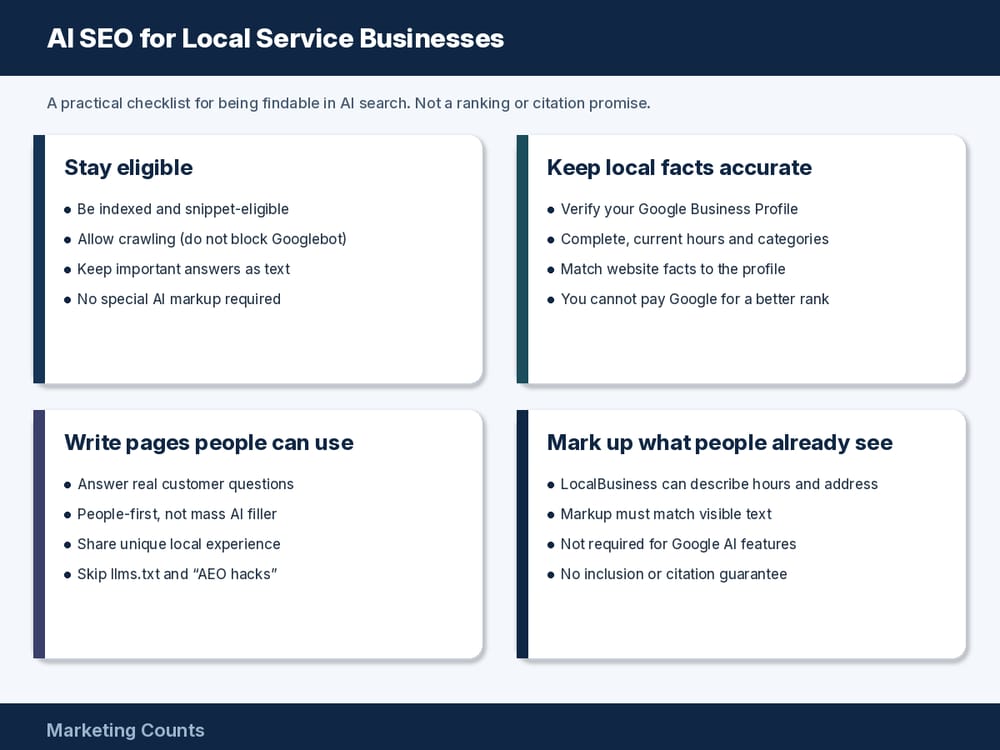
Practical AI SEO checklist for local service businesses. Not a performance claim.
Not sure where your site stands? Get a free website and marketing audit, and get clarity on what to fix next before you spend another dollar on traffic. Request your free audit.
What can you skip?
Here's what I'd skip, and why.
- Placement promises. "We'll get you into ChatGPT" or "we'll get you into AI Overviews" is a promise nobody can keep. Google says indexing and serving are not guaranteed [1], Bing says GEO does not guarantee grounding or citations [6], and the OpenAI Help Center note under [7] says placement is not guaranteed.
- Special AI files for Google. Google Search doesn't use llms.txt or special AI markup [3].
- Tools selling "internal" Google metrics. Google says to be wary of them [3].
- Content written only to trigger citations. Bing says to write for users, not to manipulate ranking systems or trigger citations or AI responses [6].
- Mass AI filler pages. Thin, automated pages are the pattern Google warns against [2].
- Paying for local rank. There's no way to request or pay for a better local ranking [5].
Where does AI fit behind the scenes?
This is where I actually like AI for this work. A Grok Bot can be a drafting assistant in the background, turning your real customer questions into first-draft FAQ answers, or comparing the hours and services on your website against your profile to flag mismatches.
A human still reviews and approves every word before it goes live. The bot drafts, you decide.
To be clear, that's paperwork, not phones. If what you need is someone, or something, picking up calls when you're closed, that's a different job, and I covered it in the AI receptionist after-hours setup guide for local services.
FAQ
Do I need special AI markup or an llms.txt file for Google?
No. Google says there are no special AI files or schema required to appear in its AI features, and Google Search does not use llms.txt or special AI markup [1][3].
If my page is indexed, will I appear in AI Overviews?
Not necessarily. Being indexed and snippet-eligible makes you eligible as a supporting link, but Google says indexing and serving are not guaranteed [1].
How is this different from regular local SEO?
Mostly, it isn't. From Google Search's perspective, AEO and GEO work is still SEO, and an accurate, verified Business Profile can help your products and services be visible in AI responses and other Search results [3][5].
Should I rewrite my pages "for ChatGPT"?
Write for your customers instead. Google asks for people-first content, Bing says to write for users rather than to trigger citations, and for ChatGPT search eligibility the technical step is allowing OAI-SearchBot [2][6][7].
Does LocalBusiness structured data guarantee I will be cited?
No. It can describe your name, address, and hours and support rich-result eligibility, but it's not required for Google's generative AI features and doesn't guarantee a rich result or a citation [3][4].
Ready to get your local facts and pages dialed in?
Here's the bottom line. The official guidance points you back to the same things good local marketing always has: be findable, be accurate, and be genuinely useful to the person trying to hire you.
If you'd rather have a team walk through your site, your profile, and your service pages with you, take a look at what we do at Marketing Counts. Best time to start is now.
Sources
- [1] Google Search Central: AI Features and Your Website
- [2] Google Search Central: Creating Helpful, Reliable, People-First Content
- [3] Google Search Central: Optimizing your website for generative AI features on Google Search
- [4] Google Search Central: Local Business (LocalBusiness) Structured Data
- [5] Google Business Profile Help: Tips to improve your local ranking on Google
- [6] Bing Webmaster Tools: Webmaster Guidelines
- [7] OpenAI: Overview of OpenAI Crawlers; see also Searching the web with ChatGPT

Hi, I Am Jane Doe
CEO Of Best Blog Ever
Lorem ipsum dolor sit amet, consectetur adipisicing elit. Autem dolore, alias,numquam enim ab voluptate id quam harum ducimus cupiditate similique quisquam et deserunt,recusandae.

Get Our Best Selling Product!
You just read about this...
Super excited about this product? We are, too! We just wrote this whole blog post that mentions it.
Ready to buy it? Get access to the Product here:

PAGES
SOCIAL
