
Pest Control AI Digital Marketing Agency: Seasonal Demand, Recurring Plans and AI
Thursday, November 26, 2026

By Paul Counts, Marketing Counts
Plan for the season. Earn the recurring plan. Skip the scare tactics.
Picture this. It's a hypothetical scene, but you've taken this call before. A homeowner just watched hundreds of winged bugs come out of a baseboard, and now they're standing in the hallway typing "termites or ants" into their phone.
Here's my question. When your company shows up in that moment, are you the calm, clear answer? Or are you one more scary sales pitch?
Season by season, here's what a pest control AI digital marketing agency should do for you, and what you can keep in house. I'll cover local SEO, content marketing, online reviews and recurring plans. No ranking promises, and no script for pushing people.
Quick disclosure. Shreya Banerjee and I are the co-owners of Marketing Counts. We're also InboxGeek partners and run an agency ourselves, so measure us by the rules in this guide too.
The short answer
A pest control AI digital marketing agency should help you get ready before swarm season and the other seasonal spikes hit. It should help customers figure out what they're seeing, and it should turn one time calls into recurring plans with honest renewal reminders. EPA tells homeowners that most pest problems can wait a few days so they have time to choose a competent company, which means scare tactics backfire. [2]
And nobody can promise you rankings.
In this guide
- A pest control marketing strategy that follows your seasons
- What a pest control AI digital marketing agency should actually do
- Before the swarm: building a regional pest calendar
- Termites or flying ants? Photo intake that routes to a real tech
- Local SEO for pest control companies
- Turning a one time call into a recurring plan without pressure
- Content marketing for pest control digital marketing
- Reputation management and online reviews
- What EPA tells homeowners to ask, and how to answer it
- A pest control AI marketing checklist
- FAQ
- Sources
A pest control marketing strategy that follows your seasons
You already know your year has a shape. Maybe it's swarmers in spring, ants when it warms up and rodents when it cools off. Your market has its own version.
A lot of pest control marketing ignores that shape. Same ad, same homepage, same message every month of the year. Then the phones blow up and nobody has time to think about marketing at all.
The reality is the work is already hard on your team. BLS says most pest control workers are employed full time, and that working evenings and weekends is common. [1] So "we'll figure out marketing when the rush hits" is not a plan.
Here's the thing. The panic call is not the win. The win is the customer who's still with you next year because you treated them right on day one.
That's a different job. BLS describes the trade as designing and carrying out pest management plans. [1] That means plans, not single visits, so your marketing should sell the same thing your techs actually deliver.
So here's the marketing strategy in one line. Get found before the rush, answer fast and honestly during it, and keep in touch after it so the one time customer becomes a plan customer. Everything below fits one of those three jobs.
What a pest control AI digital marketing agency should actually do
Let me keep this simple. A good pest control marketing agency should handle five jobs for any pest control operator, and AI can help with every one of them.
- Build a regional pest calendar before the season starts.
- Set up photo intake that routes to a licensed tech.
- Follow up after a one time service with a calm plan explanation.
- Schedule annual inspection and renewal reminders.
- Keep your license and applicator credentials visible everywhere.
One rule runs through all five. Nothing goes to a customer until a human on your team has read the draft and said yes.
What you can keep in house
A lot of this doesn't need an agency. If your office manager is comfortable with AI tools, they can draft the calendar, the follow up notes and the reminders. I wrote a practical starter plan for local service businesses that shows where to begin.
Where an agency earns its keep is the work that takes time you don't have in season. The website, the search work, the intake build and keeping it all consistent.
That's my honest take on AI marketing for pest control companies. The tools are easy, and the follow through is the hard part.
Whether your treatment history sits in ServiceTitan or another field service platform, that history is the starting point for everything below.
Before the swarm: building a regional pest calendar
A mistake a lot of companies make is starting termite marketing when the swarms start. By then the homeowner is already searching. You want your content sitting there before they pick up the phone.
Timing depends on where you are. In Mississippi, for example, the state extension service says eastern subterranean termite swarmers are black with white to clear wings and swarm during the day from the middle of February to the middle of May. [3] Your region has its own window, so check your local extension office.
Here's how AI helps. You hand it the extension sources for your service area, and it drafts a month by month pest calendar in plain language. Then your licensed tech reviews every line before it goes on the site.
That review step is not optional. AI will write a confident sentence that's wrong for your county. Your tech knows what actually shows up and when.
What to do with the calendar
Once the calendar is approved, it becomes your marketing schedule. The page about swarmers goes live before your swarm window. The emails to past customers go out before the season, not during it.
This is also how you earn termite inspection leads without yelling. A homeowner who reads a calm, local, accurate page has a good reason to call the company that wrote it. That's my opinion, not a statistic.
Termites or flying ants? Photo intake that routes to a real tech
Back to that homeowner in the hallway. They don't know what they're looking at. They want somebody to tell them.
So let them send a picture. An AI intake on your site or text line can ask for a photo, where they found the bugs, and what they noticed. It collects the details and hands them to a tech.
Here's the line I'd draw. The AI does not diagnose, and it does not recommend products. A licensed tech looks at the photo and makes the call.
Why so strict? Because a wrong answer from a bot is your wrong answer. Mississippi State Extension tells homeowners that if they find a large number of termite swarmers indoors, or see them emerge from the walls, ceilings or floors, they should call a reputable pest management professional. [3]
Be that professional. A real person who replies with what it is and what happens next is the calm answer I asked about up top. It's also where trust starts.
Local SEO for pest control companies
When a homeowner searches for help with ants or termites, the local results lean on your Google Business Profile, your website and your reviews. Local SEO for a pest control business is mostly about keeping those three accurate and useful.
Your Google Business Profile
Google's guidelines say a service area business should have one profile for the central office, with a designated service area. [4] If you run the business from home, Google says to hide your address from customers. [4]
Your business name should match the real name on your trucks, your website and your paperwork. [4] And don't load up categories with keywords, because Google says not to use categories solely as keywords. [4]
AI can compare your Google Business Profile to those rules and draft a list of fixes, plus seasonal posts and photo captions. A person on your team approves each change.
A page for each of your pest control services
Your website should have a clear page for each of the pest control services you want more of: termites, ants, rodents, mosquitoes or whatever your licenses cover. Each page should say what you do, what a visit looks like and who applies the products.
If you serve several towns, a page for each one can help, but only with real local detail. A page that just swaps the town name doesn't help homeowners or local search.
Local Services Ads and paid search
If you run Google Ads or Local Services Ads, keep the facts there identical to your profile and your site. Then track which leads turn into recurring plans, not just calls.
As a pest control operator, that's the number I'd watch. A cheap lead that never becomes a plan customer isn't cheap.
FREE CUSTOM GROWTH PLAN
Want help getting ready before swarm season?
Tell us where your business is today and where you want it to go. Shreya and I will build a custom plan and walk you through it on a call. It's free, with no obligation.
Turning a one time call into a recurring plan without pressure
The one time service is done. The customer is relieved. This is the moment a lot of companies either go silent or go hard sell.
Do neither. Have AI draft a short, calm note after the visit that explains what a plan includes and when the next visit would happen. Your office manager gives it a once over, corrects anything wrong, and sends it.
Keep it honest. Say what you treated, what you saw, what a plan covers and what it doesn't. No countdown and no "act now".
A hypothetical example
Say a family calls about ants in the kitchen, and your tech treats it. A couple of days later they get a note, approved by your office manager, that says what was done, what to watch for, and how a recurring plan would handle the next round.
That's it. No pressure, and the door stays open. Again, this is a made up example to show the idea, not a client story.
Reminders are where recurring revenue lives
Termite contracts make this easy, because the reminder is built into the contract. Mississippi State Extension says a basic annual contract generally includes a soil based termite treatment, either liquid or bait stations, and must be maintained by an annual inspection. [3]
So tie the reminder to that inspection. AI schedules it and drafts the message, a person approves it, and the message explains what the visit covers. That's what recurring pest control plans marketing really is: honest reminders, sent on time.
HVAC maintenance plans work the same way, and I covered that side in our guide for HVAC companies. Recurring revenue depends on renewal reminders that actually go out.
Content marketing for pest control digital marketing
Content marketing sounds fancy. In the pest control industry it just means answering the questions your techs hear every week, before the customer has to call.
Your approved pest calendar is the plan. Each season gets a few pieces that match what's showing up in your area.
What to write and record
- Plain answers. "Termites or flying ants?" and "Why do ants come back after rain?" written for homeowners, reviewed by a licensed tech.
- Short tech videos. A tech explaining what they look for during an inspection, filmed on a phone.
- Prevention tips. Simple things a homeowner can do between visits, with no product advice beyond what your tech approves.
- Service explainers. What a recurring plan covers, what a termite inspection looks like and what happens on the first visit.
AI drafts the first version from your tech's notes or a recorded conversation. Your tech fixes what's wrong, and nothing goes live until they sign off.
The same pieces feed your social media. One approved answer can become a short post, a photo caption and a quick video, without anyone writing from scratch.
Email marketing works best with people who already know you. A short seasonal heads up to past customers, sent before the swarm window, is the kind of email people actually open. Make it easy to unsubscribe, and keep the tone calm.
Reputation management and online reviews
Online reviews carry a lot of weight across the pest control industry, because you're asking for a spot inside someone's home. Reputation management is how you earn those reviews and respond to them.
Start with asking. After every service, send a short text or email asking for a review, and ask every customer the same way, not only the happy ones.
The rules on reviews
There's a federal rule on this. The FTC's rule makes it a violation for a business to write, create or sell a consumer review or testimonial that materially misrepresents what the rule covers. [5] The way I read it, that means no fake reviews, including one an AI wrote for you.
The rule also bans compensation or other incentives in exchange for reviews that express a particular sentiment, positive or negative. [5] So no discount for five stars. I'm a marketer, not a lawyer, so read the rule yourself or ask your attorney.
Replying to reviews
AI can draft a reply to every review, good or bad, and the owner edits and posts it. Thank people by name, mention the work if they did, and never share treatment details they didn't share first.
A bad review deserves a person's judgment, not an instant bot reply. Take the specifics offline, fix what you can, and let the public reply show you're calm and reasonable.
What EPA tells homeowners to ask, and how to answer it
Your customers can read EPA's advice the same as you can. So let's look at what it tells them.
First, slow down. EPA says that when most people discover a pest problem they want it eliminated immediately, but most problems can wait a few days. [2] It also says it's wise to get several estimates. [2]
Second, ask about credentials. One question EPA gives homeowners is whether the person doing the work will be a certified, licensed pesticide applicator or a licensed technician. [2] BLS notes that state laws require pest control workers to be licensed. [1]
Third, watch for pressure. EPA's tips flag companies that try to pressure a homeowner into signing a contract right away by suggesting the house is structurally unsound and may collapse if it isn't treated. [2]
How your marketing should answer
Answer before they ask. Put your license number on every page and say who applies the products. AI can check your pages and profiles for missing license info, and a person confirms each fix before it goes live.
Welcome the comparison. Say on your site that you're glad to be one of several estimates. In my opinion, a company that isn't afraid of being compared looks like a company worth hiring.
And give honest timelines. If it can wait until Thursday, say so. That's the part that counts when a customer decides who to keep for the long haul.
A pest control AI marketing checklist
Here's the no pressure checklist. Tape it up by the phone or pass it to whoever runs your marketing.
- Regional calendar. AI drafts it from extension sources you supply. Your licensed tech reviews it before it's published.
- Photo intake. AI asks for a photo and a description, then routes it to a tech. No diagnosis and no product advice from the bot.
- Plan explainer. After a one time service, AI drafts a calm note on what a plan includes and when the next visit would be. A person approves and sends.
- Renewal and annual inspection reminders. AI schedules and drafts them. A person approves them, and each one explains what the visit covers.
- License on every page. Show your license number and who applies the products. AI flags the gaps, and a person fixes them.
- Banned phrases list. No collapse warnings. No "today only". No made up deadlines of any kind.
- Google Business Profile check. Real name, service area, address hidden if you work from home, and a seasonal post.
- Service pages. One page per pest control service, reviewed by a licensed tech.
- Review rule. Ask every customer, reply to every review, and reward no one for a rating.
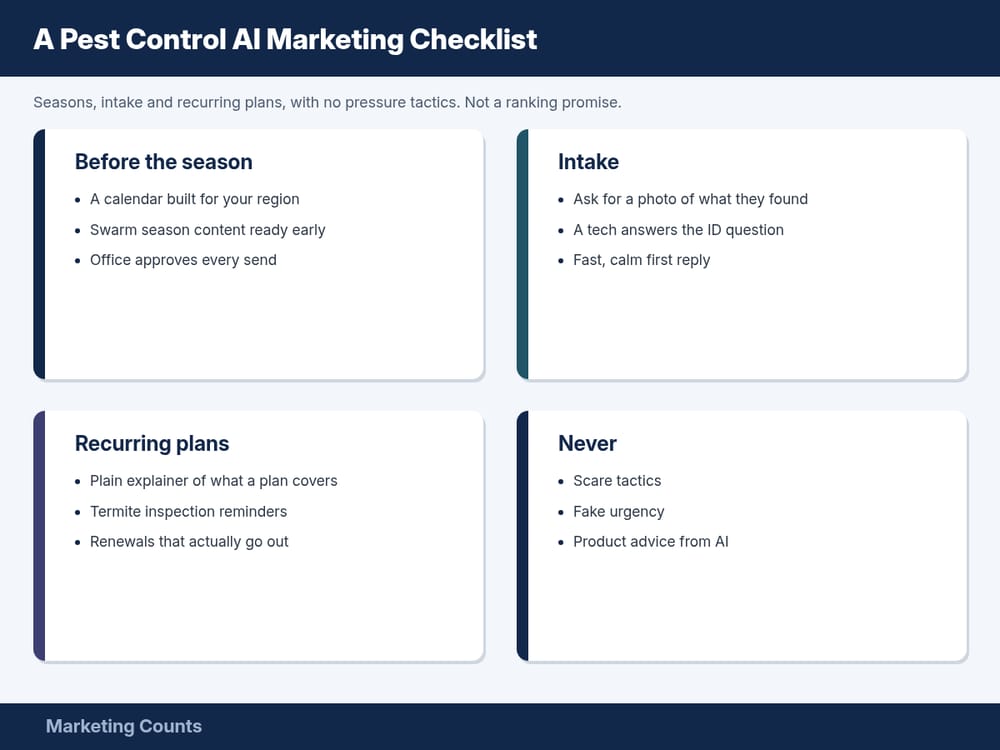
A pest control AI marketing checklist. Not a ranking promise.
One more note on that banned phrases list. Give it to the AI too. If the tool knows which words are off limits, the drafts come back cleaner and your reviewer has less to fix.
FAQ
Can AI identify the pest from a customer's photo?
It can collect the photo and the details. A licensed tech should make the call before you recommend anything.
When should a pest control company run termite season marketing?
Before swarm season in your region. In Mississippi, extension notes that eastern subterranean termites swarm from the middle of February to the middle of May, so check your local extension for your own window. [3]
Is it OK to tell customers they need treatment today?
EPA warns homeowners about pressure tactics and says most problems can wait a few days. [2] Honest timelines build trust.
Does my pest control business need social media?
It helps when it answers real questions. Reuse your approved content as short posts and videos instead of chasing daily posting.
What should every pest control page show?
Your license and who applies the products. EPA tells homeowners to ask whether the person is a certified, licensed applicator. [2]
Where to start this week
Don't try to do all of this at once. Pick the next seasonal spike on your calendar and work backward from it. Get the calendar page drafted, reviewed by a tech, and live before the calls start.
Then add the follow up note and the reminders. Whether you hire a pest control AI digital marketing agency or keep it in house, the standard is the same. Be the calm, clear answer, and earn the recurring plan.
REQUEST A QUOTE
Ready for a plan built around your pest control business?
Tell us about your goals. Shreya and I will map out the fastest wins with AI marketing, automation, funnels and email, then walk you through the plan on a call. Free, and no obligation.
Sources
[1] U.S. Bureau of Labor Statistics, Occupational Outlook Handbook: Pest Control Workers
[2] U.S. Environmental Protection Agency: Tips for Selecting a Pest Control Service
[3] Mississippi State University Extension Service: Protect property from heavy termite swarms (May 19, 2026)
[4] Google Business Profile Help: Guidelines for representing your business on Google
[5] eCFR (Federal Trade Commission rule): 16 CFR Part 465, Use of Consumer Reviews and Testimonials

Hi, I Am Jane Doe
CEO Of Best Blog Ever
Lorem ipsum dolor sit amet, consectetur adipisicing elit. Autem dolore, alias,numquam enim ab voluptate id quam harum ducimus cupiditate similique quisquam et deserunt,recusandae.

Get Our Best Selling Product!
You just read about this...
Super excited about this product? We are, too! We just wrote this whole blog post that mentions it.
Ready to buy it? Get access to the Product here:

PAGES
SOCIAL

Social media and email marketing