
What Is an AI Marketing Agency? A Local Service Business Owner's Guide to Hiring One
Monday, November 16, 2026
By Paul Counts, Marketing Counts
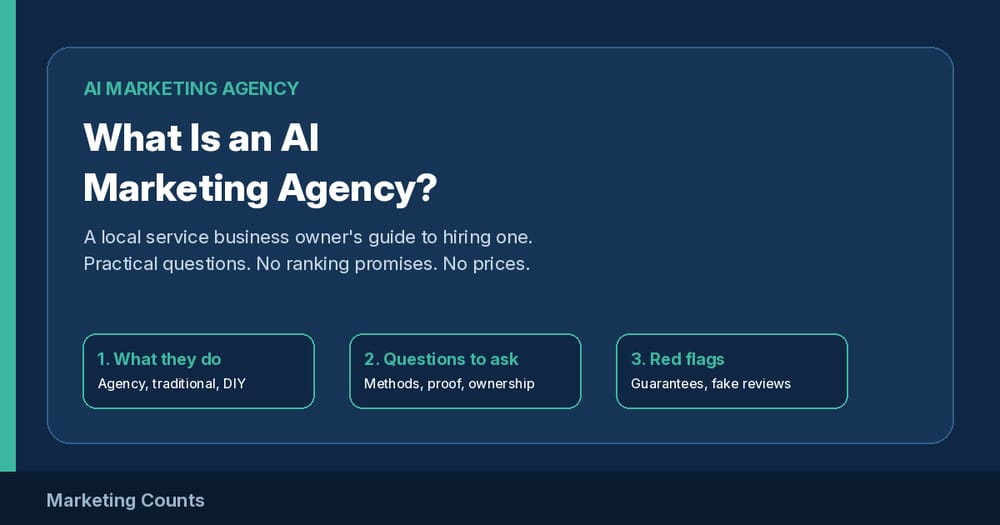
Know what you're hiring. Ask before you sign. Watch for red flags.
Someone just told you that you need an AI marketing agency. Maybe it was a cold call, maybe it was a guy at a networking breakfast. Before you sign anything, what does that actually mean?
Alright, here's what we're gonna do. I'm gonna walk you through what an AI marketing agency actually does, how that compares to a traditional agency and to doing the work yourself, what to ask, and what to walk away from.
Here's what this guide won't do. It won't promise you rankings, and it won't tell you that you have to hire anybody. Full disclosure, Shreya and I run Marketing Counts and we do marketing work for businesses, so hold us to the same questions I'm about to hand you.
The short answer
An AI marketing agency is a marketing company that uses AI tools to help do some of the work, things like drafting, research, and reporting. That's my plain-language description, not a legal definition.
A good one should be able to explain the work it will do for you, in plain English. If all you get is the same old pitch with "AI" added to it, that's a label, not a service.
Two more things before we dive in. Hiring help is optional, and no one can in good faith guarantee you a ranking or a spot in an AI search answer. You with me?
In this guide
- What does an AI marketing agency actually do?
- How is it different from a traditional digital marketing agency?
- Can you do this work yourself?
- Is it really AI or just a label?
- What should you ask before you sign?
- What are the red flags on rankings and AI placement?
- What about fake reviews and review incentives?
- What if they publish content for you?
- What does a sensible first 90 days look like?
- Your hiring checklist
- FAQ
What does an AI marketing agency actually do?
The reality is, a lot of it is the same work a marketing agency has always done. Your website, local search, ads, content, follow-up, and reporting. What's supposed to change is how the work gets done.
So a real answer has three parts:
- The work. What they will actually do for you each month.
- The tools. Which AI tools they use, and for which jobs.
- The human review. Who checks the output before it goes out under your business name.
If they can't walk you through those three, the label doesn't tell you much.
Here's how that sounds on our side. At Marketing Counts, a Grok Bot works as a behind-the-scenes drafting assistant, and a human still approves the work. That's the kind of plain answer you should expect from anybody you interview.
A quick hypothetical
This is a hypothetical example, not a real client result. Say a plumber asks two agencies what "AI-powered" means.
Agency A says, "Our proprietary AI gets you found everywhere." Agency B says, "We use AI to draft your service page updates and your monthly report, a person on our team fact checks every draft, and you see it before it publishes."
Agency B gave that plumber something he can check. Agency A gave him a slogan.
How is it different from a traditional digital marketing agency?
Often, less than the pitch suggests. Many of the same channels still apply, like your website, your local search presence, your reviews, your ads, and your email follow-up.
A mistake a lot of people make is assuming "AI" automatically means better. It doesn't. The FTC has told advertisers that a claim that an AI product beats a non-AI product needs adequate proof behind it, and if that proof can't be had, the claim shouldn't be made. [1]
That same guidance warns companies not to exaggerate what an AI product can do. [1] So when somebody tells you their AI approach beats the old way, your question is simple: "Compared to what, and how do you know?"
AI can speed up drafting and research. Faster is not the same thing as better for your business, and somebody still has to know your market and check the work.
Can you do this work yourself?
A lot of it, yes. Google's own guidance on hiring SEO help says the owner of a small local business can probably handle much of the work in-house. [4]
That same page is fair to both sides. It says hiring help can potentially improve your visibility and save you time, and it also says an irresponsible provider can damage your site and your reputation. [4]
So here's the thing. You're trading your time against somebody else's time, plus the risk of picking wrong.
If you want to start in-house, I already laid that out in AI Marketing for Local Service Businesses: A Practical Starter Plan. Work through the basics there first, then decide whether you need help.
You're not behind
One bit of context. The U.S. Census Bureau looked at business survey data collected from mid-December 2025 through early May 2026, and overall AI use hovered between 17% and 20%. Among firms with four or fewer employees, less than 20% reported using AI. [7]
I'm not sharing that to push you in either direction. If you haven't figured out AI yet, you've got plenty of company, and there's no reason to sign something out of panic.
Is it really AI or just a label?
The FTC put a blunt question to companies making AI claims: "Does the product actually use AI at all?" [1] Borrow that question. It's a good one.
The same guidance points out that merely using an AI tool somewhere in the development process is not the same as a product having AI in it. [1] In owner terms, somebody using a chatbot to write your proposal doesn't make the service "AI-powered."
So what I want you to do is ask them to show you. Which tool, doing which job, checked by which person?
If the answer is still fuzzy after two tries, treat the "AI" part as decoration.
What should you ask before you sign?
Google publishes interview questions for anyone hiring SEO help, and they adapt well to any marketing agency. [4] Here's my version for a local service owner:
- 1. Can you show me examples of your prior work?
- 2. What results do you expect, and in what timeframe?
- 3. How will you measure success, and will I see those numbers?
- 4. Will you explain the changes you make, in plain English?
- 5. What's your experience in my industry and in my local area?
- 6. Do you follow Google's published Search Essentials?
Then one more that's mine, not Google's, and it's a practical question, not a legal rule. Who owns the ad accounts, the website, the analytics, and the content if we part ways?
Here's why that one counts. If the relationship ends and everything sits in their name, you could be starting over from zero. Get the answer in writing before any work begins.
What are the red flags on rankings and AI placement?
Google is about as clear as it gets on this. An agency that guarantees first place is one to walk away from, because a #1 ranking is not something anyone can promise. [4]
Here's what to watch for, straight from that same guidance: [4]
- A guaranteed ranking or position
- A claimed "special relationship" with Google
- A "priority submit" to Google
- Secrecy about what they're actually doing to your site
- Any hint that buying ads will lift your organic rankings (Google says it never takes money to include or rank sites in organic results)
One more piece people miss. You're responsible for the actions of the companies you hire. [4] If they cut corners, it's your site and your name on the line.
The newer version of this pitch is "we'll get you into AI Overviews" or "we'll get ChatGPT to recommend you." Same red flag, new wrapper.
What about fake reviews and review incentives?
This one can get you in real trouble. On September 25, 2024, the FTC announced Operation AI Comply, an enforcement sweep aimed at deceptive AI claims and schemes. [2]
One of the cases announced that day involved an AI writing tool that let customers generate fake reviews. FTC Chair Lina M. Khan said it plainly: "Using AI tools to trick, mislead, or defraud people is illegal." [2]
There's also a federal rule on the books, 16 CFR Part 465. [3] Among other things, it prohibits a business from:
- Writing, creating, or selling fake reviews or testimonials
- Buying reviews the business knew, or should have known, were fake
- Paying or offering incentives in exchange for a particular sentiment
So if an agency offers to "handle your reviews" by generating them with AI, buying them, or rewarding customers only for five stars, that's your cue to leave. I'm not a lawyer, so read the rule yourself or ask one if you're unsure.
What if they publish content for you?
A lot of AI agencies sell content. Blog posts, service pages, location pages, lots of them, fast. Volume is not the goal.
Google says its ranking systems are built to prioritize helpful, reliable information made for people, not content made to manipulate rankings. [5] It also says it has no preferred word count, so "we write 2,000 words because Google likes that" is a tell. [5]
Does AI content get a pass, or a penalty?
Neither. Google says generative AI can help with research and with adding structure to original content. [6] Using it to crank out many pages that add no value for users may violate Google's spam policy on scaled content abuse. [6]
Using automation, AI included, mainly to manipulate rankings is a spam-policy violation. [5] And using AI doesn't hand your content any special ranking gains either. [6]
Who checks the draft?
This is the question that counts most. Google's guidance says AI-generated content should be manually fact checked and reviewed before it publishes, and that includes titles, meta descriptions, and image alt text. [6]
So ask the agency who does that review, and ask to see a draft before it goes live. Remember, it's your phone number, your service area, and your reputation on that page.
What does a sensible first 90 days look like?
Real quick, this part is practical advice from me. It's not a guarantee, and it's not a packaged offer.
Days 1 to 30: get the facts straight.
- Confirm your business facts are correct and consistent everywhere (name, address, phone, hours, services, service area)
- Confirm you own, or have full access to, your website, ad accounts, and analytics
- Review the pages you already have before anybody creates new ones
- Agree on a report a human can check, with numbers you can look up yourself
Days 31 to 60: fix before you build.
- Clean up existing pages first
- Review any AI drafts yourself before they publish
- Ask them to explain each change in plain English
Days 61 to 90: check the work.
- Sit down with the report together
- Decide what to keep, what to adjust, and what to stop
Notice what's not on that list. Nobody started with a first-place promise or a promise that an AI tool will cite you. Does that make sense?
Your hiring checklist
Make a note of this. Before you sign with any AI marketing agency:
- They can explain the work, the tools, and the human review
- They can show you where AI is actually used, not just the label
- They answered the interview questions without dodging
- You know, in writing, who owns the accounts, the website, the analytics, and the content
- No guaranteed rankings, and no guaranteed spot in AI answers
- No "special relationship" with Google and no secrecy
- No fake, bought, or sentiment-for-pay reviews
- A human fact checks AI drafts, and you see them before they publish
- The first 90 days starts with your facts and your existing pages, not a promise
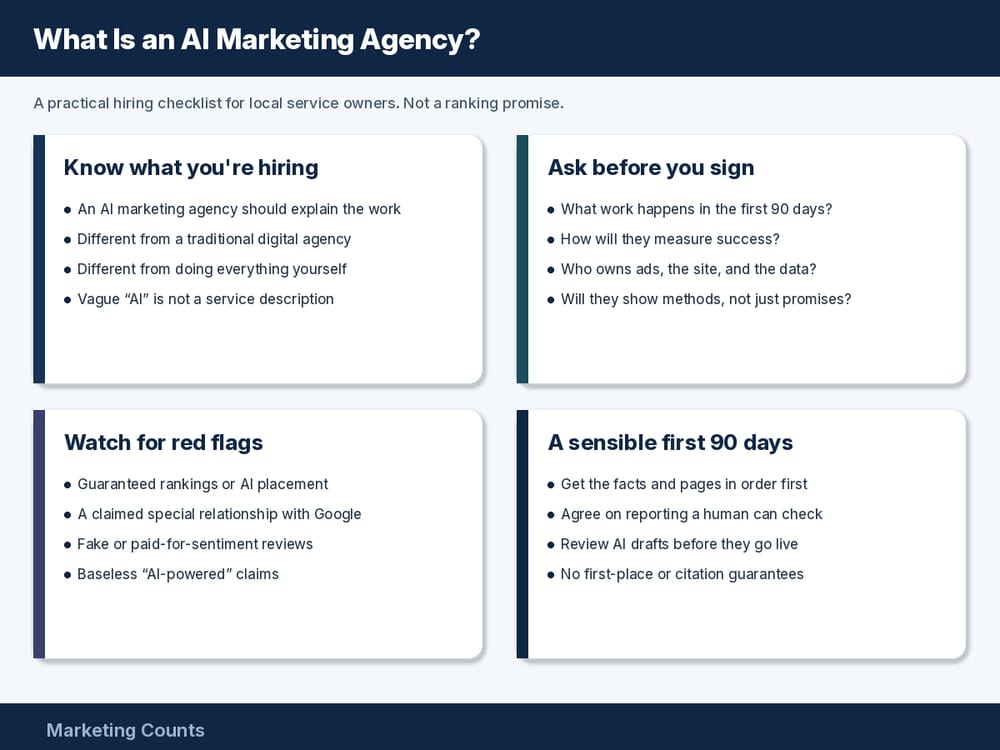
A practical hiring checklist for local service owners. Not a ranking promise.
Want a second set of eyes before you hire anybody? Get a free website and marketing audit and get clarity on what to fix next. Then you can decide whether to handle it in-house or bring in help.
FAQ
What is an AI marketing agency, in plain language?
It's a marketing company that uses AI tools to help with some of the work, like drafting, research, and reporting. That's a plain description, not a legal definition. A good one can explain the work, the tools, and the human review.
How is that different from a regular digital marketing agency?
Many of the same channels still apply, so the difference is mostly in how the work gets done. "AI" is not automatically better. The FTC says a claim that an AI product outperforms a non-AI product needs adequate proof. [1]
Can I just do this work myself?
Much of it, probably. Google's guidance on hiring SEO help says a small local business owner can likely do a lot of the work in-house. [4] Hiring help is optional.
What hiring claims should I walk away from?
Guaranteed rankings, a guaranteed spot in AI answers, a "special relationship" with Google, and secrecy about the work. [4] Also walk away from fake, bought, or sentiment-for-pay reviews. [2] [3]
What should a sensible first 90 days look like?
Start with your business facts, your account access, and your existing pages. Agree on reporting a human can check, and review AI drafts before they publish. It should not start with a first-place or AI-citation promise.
Where to go from here
Here's the thing. "AI" is not the question. The question is whether the people you're about to pay can explain the work, show you the numbers, and leave you owning your own accounts.
Ask the questions. Watch for the red flags. And if you decide to do the basics yourself first, that's a perfectly good answer too.
Sources
[1] FTC: Keep your AI claims in check (archived). The original official page was not available on the live FTC site as of November 16, 2026. Quotations were confirmed from an Internet Archive snapshot of that official page (last successful capture March 17, 2025).
[3] eCFR: 16 CFR Part 465, Rule on the Use of Consumer Reviews and Testimonials Footnote: see the Federal Register final rule, effective October 21, 2024.
[4] Google Search Central: Do you need an SEO?
[5] Google Search Central: Creating Helpful, Reliable, People-First Content
[6] Google Search Central: Google Search's guidance on using generative AI content on your website Footnote: the point that AI use brings no special ranking gains comes from the Google Search blog, which also says appropriate use of AI or automation is not against its guidelines.
[7] U.S. Census Bureau: Large Firms With at Least 20 Employees Biggest AI Users

Hi, I Am Jane Doe
CEO Of Best Blog Ever
Lorem ipsum dolor sit amet, consectetur adipisicing elit. Autem dolore, alias,numquam enim ab voluptate id quam harum ducimus cupiditate similique quisquam et deserunt,recusandae.

Get Our Best Selling Product!
You just read about this...
Super excited about this product? We are, too! We just wrote this whole blog post that mentions it.
Ready to buy it? Get access to the Product here:

PAGES
SOCIAL
