
Roofing AI Marketing Services: Turning Storm Season Calls Into Booked Inspections
Thursday, November 26, 2026
By Paul Counts, Marketing Counts
Answer the storm fast. Prove you are the safe local choice.
The morning after a hailstorm is where roofing AI marketing services either earn their keep or get in your way. So picture one with me. The scene is invented, but the morning will feel familiar.
Your voicemail box filled up overnight. A truck with out of state plates is already knocking on doors in your neighborhood. And a homeowner down the street just read FEMA's warning about contractors who show up first.
So here's the question. How do you look like the safe choice?
Below, I'll sort the AI marketing services that help a roofing company, say which to set up first, and flag what belongs in human hands. I'll also cover your Google Business Profile, local SEO, getting more roofing leads and what to do when the phone goes quiet. No prices here, and no ranking promises.
Before we start, you should know who's talking. Marketing Counts is co-owned by Shreya Banerjee and me. We're InboxGeek partners, we've helped 100,000 people globally, and we sell this kind of work, so judge us by the yardstick you'd use on anybody.
The short answer
Roofing AI marketing services should help you answer the after the storm flood fast and book inspections with photos and addresses in hand. They should also show homeowners the trust signals FEMA tells them to check: local, licensed, insured, written estimates [2].
They should never invent damage, reviews or urgency. And nobody can promise you rankings.
In this guide
- What happens to a roofing company's phone after a storm?
- Where AI marketing services actually help roofing contractors
- Turning the after the storm flood into booked inspections
- Can an AI agent answer calls and book appointments?
- Looking like the safe local choice
- Google Business Profile and local SEO for roofing companies
- Follow up that does not feel like a storm chaser
- How do you get more roofing leads that turn into jobs?
- Reviews after a busy season, done the legal way
- Staying visible in the slow season
- What should a roofing business keep human?
- A roofing AI marketing checklist
- Frequently asked questions
- Sources
What happens to a roofing company's phone after a storm?
Roofing already runs hot and cold. The Bureau of Labor Statistics notes that roofers may work overtime to finish a job, especially during busy summer months [1]. Then a storm lands on top of that.
Now everybody calls at once. Some of them have water coming through the ceiling right now, and some just want somebody to take a look.
A mistake a lot of roofing companies make is treating all of those calls the same. First voicemail in, first call back. The reality is an active leak and a "can you come look" request are two different jobs.
And while you're digging through voicemail, somebody else is standing on the porch. FEMA says out of town scam artists may be the first to arrive at your front door after a flood [2]. I'd bet hail and wind bring the same worry, but that part is my view, not FEMA's.
So you've got two problems at the same time: speed and suspicion. You have to solve both, and you solve speed first.
And every one of those calls is a roofing lead you already earned. Let it sit in voicemail, and you've handed it to somebody else.
Where AI marketing services actually help roofing contractors
Here's the order I'd work in if I were setting up AI marketing for roofing contractors this season.
- Storm surge intake. Collect the details and sort urgent leaks from inspection requests.
- Inspection booking and reminders. Draft the confirmation and reminder messages.
- Trust content. Draft the page that answers the storm chaser fear.
- Estimate follow up. Draft answers to the questions people ask after the estimate.
- Review requests. Ask every finished customer, the legal way.
- Google Business Profile and website upkeep. Draft updates so your listing and your pages stay current all year.
Notice what's not on that list. There's no AI deciding what a roof needs, and no AI sending anything on its own. In every one of these, the AI handles the first draft and somebody in your office decides what actually goes out.
Your inspection list may live in ServiceTitan, a roofing CRM or another field service platform. I'm not going to make claims about what any tool connects to. Ask your vendor how intake details get into the system you already use.
One quick aside. BLS says some roofing demand may come from installing solar photovoltaic panels on rooftops [1].
If your crews coordinate with an electrician on those jobs, build that handoff into your intake too. Our guide for electrical contractors covers that side of the job.
Turning the after the storm flood into booked inspections
Start with intake, because this is where roof inspection leads get won or lost. An AI form or text intake can ask the same questions every time, in the middle of the night, without getting tired.
Have it collect four things:
- The address
- Photos of what the homeowner can see
- The age of the roof
- Whether there's an active leak right now
Then let it sort. Active leaks go in one pile and inspection requests go in the other, so your office books the right slot first.
Here's the human step. Somebody in your office looks at the sorted list and confirms every appointment. The AI suggests the order, and your team decides it.
Here's a made up example. A homeowner texts a midnight photo of a dripping ceiling stain. The intake flags an active leak, and your office manager sees it first thing and calls to confirm the slot.
What should the confirmation say?
AI can draft a message that covers who is coming, when, and what to expect at the inspection. BLS describes part of the job as inspecting problem roofs to determine the best way to repair them [1]. So say that in plain words: we're coming to look, and then we'll tell you what we found.
Keep the draft honest. No damage talk before anybody has been on the roof. A person on the team reads it and hits send, and the same goes for the reminder.
Can an AI agent answer calls and book appointments?
Yes, with limits you set. An AI agent, sometimes sold as an AI receptionist, can pick up when your office line is buried after a storm and ask the same intake questions as your form.
Here's the part that saves your office the most time. If you give it the inspection slots your crews actually have open, it can offer those times and book appointments for plain inspection requests.
Where the AI agent should stop
Active leaks are different. The agent flags them and hands them to a person right away, because someone with a wet ceiling should hear a human voice fast.
I'd also keep these rules in place:
- It says what it is. The agent tells callers it's an automated assistant for your company.
- It never talks damage or price. That comes after a roofer has been on the roof.
- It uses approved wording. Your team writes the script once and reviews it before storm season.
- It hands off easily. A caller who asks for a person gets one, or gets a call back from one.
Every booked inspection lands in your CRM or schedule for your office to confirm. The agent answers. Your team owns the calendar.
FREE CUSTOM GROWTH PLAN
Want help getting ready before the next storm?
Tell us where your business is today and where you want it to go. Shreya and I will build a custom plan and walk you through it on a call. It's free, with no obligation.
Looking like the safe local choice: what FEMA tells homeowners to check
Here's the thing about storm damage roofing marketing. The homeowner isn't only comparing roofers. They're trying to work out who is safe to let on the roof.
FEMA hands them a short list:
- Use a local contractor, someone who is known in the community [2].
- Get two or three written estimates [2].
- Verify the contractor's license and insurance [2].
- Beware of contractors who ask for large payments up front to purchase materials [2].
Most roofers read that as a list about the other guy. I read it as your marketing plan. If a homeowner is going to check those four things, make all four easy to find on your website.
Turn FEMA's list into your own page
So build a page called something like "How to check any roofer, including us." AI can draft it from FEMA's advice. Then the owner adds the real details: your license, your insurance, your service area, and how your written estimates work.
Don't let AI fill in those blanks. If you leave a gap, it will guess, and a guessed license detail is worse than no page at all. The owner types those in and signs off before it goes live.
Tell people to get other estimates, too. FEMA already told them to [2]. Saying it yourself reads as confidence, and I think it's the strongest line on the page.
One more rule. Don't name competitors and don't call anybody a storm chaser. Point to FEMA's advice and let the homeowner do the checking.
Google Business Profile and local SEO for roofing companies
When a homeowner looks for a roofer near them, your Google Business Profile is often the first thing they see. Local SEO for roofing companies starts there, with facts that are accurate and match your website.
Keep your Google Business Profile accurate
Google's guidelines say service area businesses should have one profile for the central office, with a designated service area [4]. If you run your roofing business from home, Google says to hide your address from customers [4].
Your business name should match the real name you use on your trucks, your website and your paperwork [4]. And don't stuff categories with keywords, because Google says not to use categories solely as keywords [4].
Keep it active, especially around storms
Google doesn't publish exactly how profile activity affects where you show up, so I won't promise rankings. But homeowners notice a profile that looks alive.
AI can draft the routine work for a person to approve and post:
- Storm updates. Changed hours, how to request an inspection and what to expect this week.
- Job photos. Finished roofs, with the homeowner's permission and no addresses showing.
- Review replies. A short, specific thank you or a calm response to a complaint.
Local SEO pages on your website
Your website should have a clear page for each of your main services. If your roofing contractors work in several towns, a page for each one with real local details helps homeowners and local search.
Pages that only swap the town name don't help anybody. AI drafts, and someone who knows the area adds real projects and roof types.
Follow up that does not feel like a storm chaser
The estimate is out. Now what? A lot of roofers either go quiet or start pushing, and in my view both cost you jobs.
AI can draft follow up that answers the common questions: what happens next, how scheduling works, and what your written estimate covers. That's helpful, and helpful is what a nervous homeowner remembers.
Here's what stays out: fake deadlines, pressure, and lines like "we're only in your area this week." That's the exact behavior the homeowner was warned about.
Somebody on your team reads each follow up before it goes. If the homeowner asked a specific question at the inspection, the person who was there should answer it.
Put every open estimate in your CRM with a follow up stage and a date. Then nothing falls through the cracks when the storm work piles up, and AI can remind your team who is due for a check in.
Hold your marketing help to that standard, too. If you're thinking about bringing in a roofing digital marketing agency, the same questions apply when you hire a marketing agency, and I laid them out in this guide to hiring an AI marketing agency. Check us the same way.
How do you get more roofing leads that turn into jobs?
More roofing leads only help if they turn into booked inspections and signed jobs. So before you spend more on Google Ads or a lead service, look at what happens to the leads you already get.
Track where every lead comes from
Have your CRM record the source of every roofing lead: your website, your Google Business Profile, Google Ads, a referral or a yard sign. AI can sum it up each week in plain words.
Then compare that against booked inspections and signed jobs, not just calls. Lots of calls and no jobs isn't a good source.
Campaigns that fill the calendar
AI is good at drafting campaigns, and a person should approve every one. Here are the ones I'd plan first:
- Storm prep campaign. Before your storm season, an email to past customers about what to check and how to reach you.
- After the storm campaign. A short note to past customers in the affected area, offering an inspection, with no scare tactics.
- Past customer check in. A yearly reminder for an inspection or a gutter cleaning, if you offer it.
Keep every campaign honest: no invented damage and no fake deadlines.
Reviews after a busy season, done the legal way
After a big storm season you've got a pile of finished jobs. That's the best time to ask for reviews, and the easiest time to get it wrong.
There's a federal rule on this. The FTC's rule makes it a violation for a business to write, create or sell a consumer review or testimonial that materially misrepresents what the rule covers [3]. The way I read it, that means no fake reviews, and that includes one an AI wrote for you.
The rule also bans compensation or other incentives given in exchange for reviews that express a particular sentiment, positive or negative [3]. So no discount for five stars.
Here's the simple rule for the office. Ask every finished customer, ask them all the same way, and reward nobody for a rating.
AI can draft the request. A person confirms the job is actually closed out, then sends it. And I'm a marketer, not a lawyer, so read the rule yourself or ask your attorney.
Staying visible in the slow season
BLS notes that in northern states, roofing work may be limited during the winter months [1].
That quiet stretch is when you build for the next rush. Roofing companies that stay visible all year are easier to find, and easier to trust, when the next storm hits.
Here's what I'd work on:
- Keep posting to your Google Business Profile. Finished jobs, seasonal tips and honest updates, approved by a person.
- Write the pages you never had time for. Roof repair, replacement, inspections and what your written estimates cover.
- Run the past customer campaign. A checkup reminder keeps your company in mind.
- Rehearse storm day. Test the intake, the AI agent script and the confirmation texts before you need them.
What should a roofing business keep human?
Use AI for the typing. Keep the judgment with people. Here's my list:
- What the roof needs. That call gets made on the roof, by a roofer.
- Estimates and scope. A person writes them and stands behind them.
- License and insurance details. The owner enters them and keeps them current.
- Anything about insurance claims. Stick to the process steps you actually follow, and send coverage questions to the homeowner's insurer.
- The final send. Every text, email, page and review request gets a human approval.
- The hard conversations. An upset homeowner with a wet ceiling should get a person.
None of that slows you down much. Your team is reading and approving, not starting from a blank screen.
A roofing AI marketing checklist
Get this dialed in before the next storm, not during it.
Storm day checklist
- Intake fields: address, photos, roof age and active leak status.
- Urgent versus inspection sort: AI sorts, a person confirms before booking.
- Confirmation text: drafted ahead of time, approved, and clear about what to expect.
- Trust page: local, licensed and insured, with license and insurance details the owner added.
- Written estimate template: ready to go, so every homeowner gets it in writing.
- Review request rule: ask everyone, reward no one for a rating.
- AI agent script: approved wording, active leaks handed to a person, and an easy way to reach a human.
- Google Business Profile check: real name, service area, address hidden if you work from home, and a recent update.
- CRM follow up stages: every open estimate has a next step and a date.
- Slow season plan: one campaign, one new service page and a storm day rehearsal.
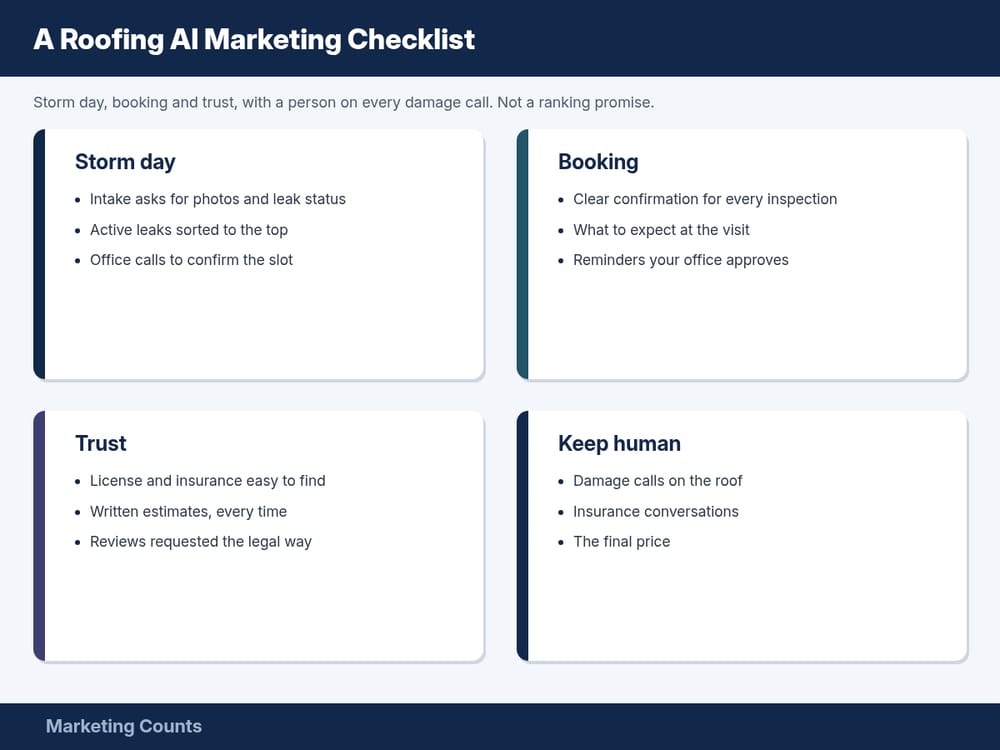
A roofing AI marketing checklist. Not a ranking promise.
Frequently asked questions
Can AI help me handle calls after a storm?
Yes. It can collect addresses, photos and leak status so your team books the most urgent jobs first. A person still confirms each appointment.
Should my marketing mention storm chasers?
You can point homeowners to FEMA's general advice on checking any contractor, including you [2]. Don't attack competitors by name.
Can I offer a discount for a five star review?
No. The FTC's review rule bans incentives tied to a positive or negative sentiment [3]. Ask everyone, and reward no one for a rating.
Can AI write insurance claim advice for my site?
Keep it to the process steps you actually follow, and stay away from legal or insurance advice. Homeowners should talk to their insurer. A person on your team approves the page before it goes up.
Does posting on my Google Business Profile help me rank?
Google doesn't publish that, and nobody can promise you rankings. Keep the profile accurate under Google's guidelines [4] and current, because homeowners check it before they call.
Where to start this week
You can't control when the storm hits. You can control how fast you answer and how easy you are to check.
So start with one thing. Set up the intake, build the trust page or clean up your Google Business Profile, and have a person approve every word. That's what good roofing AI marketing services look like to me: fast on the front end, human where it counts.
REQUEST A QUOTE
Ready for a plan built around your roofing business?
Tell us about your goals. Shreya and I will map out the fastest wins with AI marketing, automation, funnels and email, then walk you through the plan on a call. Free, and no obligation.
Sources
[1] U.S. Bureau of Labor Statistics, Occupational Outlook Handbook: Roofers
[3] eCFR (Federal Trade Commission rule): 16 CFR Part 465, Use of Consumer Reviews and Testimonials
[4] Google Business Profile Help: Guidelines for representing your business on Google

Hi, I Am Jane Doe
CEO Of Best Blog Ever
Lorem ipsum dolor sit amet, consectetur adipisicing elit. Autem dolore, alias,numquam enim ab voluptate id quam harum ducimus cupiditate similique quisquam et deserunt,recusandae.

Get Our Best Selling Product!
You just read about this...
Super excited about this product? We are, too! We just wrote this whole blog post that mentions it.
Ready to buy it? Get access to the Product here:

PAGES
SOCIAL
